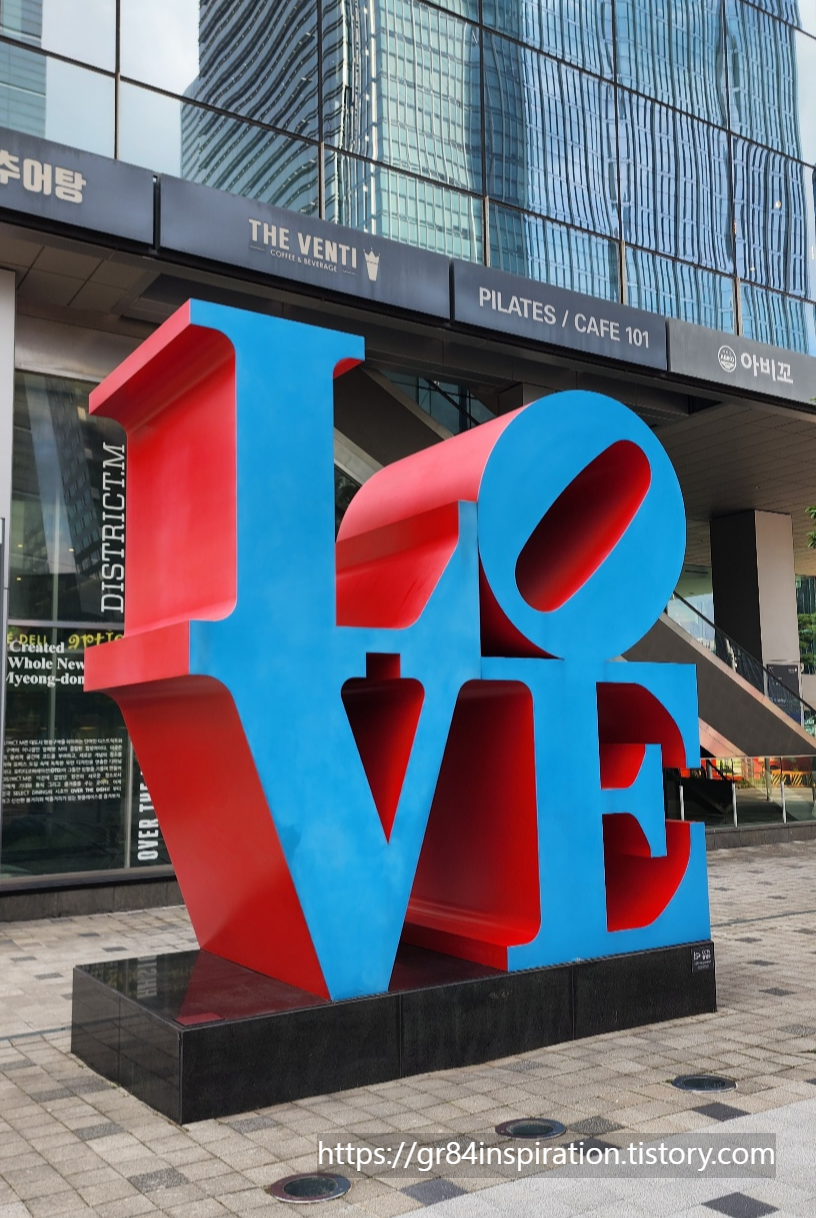
로버트 인디애나 Robert Indiana — 거리에서 만난 팝아트의 상징, LOVE
거리에서 만난 예술, 손끝으로 다시 만나다 — 로버트 인디애나의 LOVE.
지난 발렌타인데이에 저희 가족은 서로를 위한 작은 선물로 LEGO의 ‘LOVE’ 블럭을 만들었습니다. 아이와 함께 조립하는 시간은 단순한 놀이가 아니라 작은 예술 체험 같았습니다. 블럭 하나하나를 쌓아 올리다 보니 그 구조가 자연스럽게 손에 익고, 기울어진 ‘O’가 주는 독특한 긴장감도 새삼 눈에 들어왔습니다. 아이 역시 “내가 직접 만든 예술 작품”으로 기억하며 뿌듯해하는 모습이 인상 깊었습니다. 아직도 거실에 장식해 둔 블록을 보면서 재미있게 만들었던 순간이 떠오르곤 합니다.
이 LEGO 경험은 자연스럽게 뉴욕 거리, 도쿄 미술관, 그리고 서울 명동 한복판에서 보았던 로버트 인디애나의 대표작 LOVE 조각을 떠올리게 했습니다. 우리가 익숙하게 지나쳤던 작품이 다시 손끝의 기억으로 연결되며, 예술이 일상 속에 얼마나 가까이 와 있는지를 체감할 수 있었던 순간이었습니다.
단순함 속의 강렬한 메시지
로버트 인디애나(1928–2018)는 미국 인디애나주 출신의 현대미술가로, 팝아트의 거장으로 불립니다. 그는 시카고예술대학에서 공부한 뒤 1960년대 뉴욕 화단에서 앤디 워홀, 로이 리히텐슈타인과 나란히 활동했습니다. 하지만 인디애나의 길은 조금 달랐습니다. 광고적 이미지에 집중했던 동시대 작가들과 달리, 그는 단어와 숫자를 예술 언어로 전환하는 데 몰두했습니다.
그 배경에는 개인적인 삶의 흔적이 있습니다. 고아원에서 자라며 거리의 간판과 숫자를 유난히 유심히 보았던 그는, 문자와 기호를 작품 속에서 재해석했습니다. 단순한 알파벳과 숫자에 색과 배치를 부여하여 감정과 사회적 메시지를 응축시킨 것이지요.
세계적인 아이콘, LOVE
대표작 LOVE는 1964년 뉴욕현대미술관(MoMA)의 크리스마스 카드 디자인으로 처음 등장했습니다. 인디애나는 ‘사랑’이라는 단어를 네 개의 대문자로 분할하고, ‘O’를 기울여 배치함으로써 사랑의 불완전성과 긴장감을 상징했습니다. 이후 1966년 입체 조각으로 제작된 LOVE는 폭발적인 반응을 얻으며 세계 곳곳에 설치되었고, 오늘날에는 관광객들의 기념사진 필수 배경으로 자리 잡았습니다.
뉴욕 맨해튼, 도쿄 신주쿠, 필라델피아, 서울 명동까지—도시마다 놓인 LOVE 조각은 서로 다른 문화 속에서도 동일한 감정을 전합니다. 짧은 단어지만 시대와 장소를 넘어 보편적인 메시지를 던지는 힘, 이것이 인디애나 작품의 매력일 것입니다.
예술의 확장 — HOPE와 다른 시리즈
2008년 미국 대선 당시, 인디애나는 버락 오바마의 캠페인을 지지하며 새로운 작품 HOPE를 발표했습니다. 빨강·파랑·흰색으로 구성된 이 단어는 정치적 메시지를 시각적으로 전달하며 큰 반향을 일으켰습니다. 희망이라는 단어가 예술을 통해 대중에게 확산되는 순간이었지요.
또한 인디애나는 Numbers 시리즈를 통해 숫자 하나하나를 색과 형태로 재해석했습니다. 태어난 해, 개인의 기억, 사회적 의미가 뒤섞여 표현된 숫자는 단순한 기호를 넘어 인간의 삶을 상징하는 조형물로 자리 잡았습니다. 또한 1970년대에는 EAT라는 작품을 선보이며, 인간의 가장 본질적 행위조차 예술적 언어로 끌어올린 바 있습니다.
LEGO에서 시작된 작은 깨달음
저에게 LEGO 블럭으로 LOVE를 만든 경험은 단순한 가족 놀이를 넘어선 예술적 대화였습니다. 거리에서 무심히 지나쳤던 조각이 다시 손끝의 기억으로 소환되며, ‘예술은 곁에 있다’는 사실을 확인한 순간이었습니다.
예술은 거창한 전시장 안에만 머물지 않습니다. 거리의 조각, 집 안의 작은 오브제, 그리고 아이와 함께한 블록 하나까지도 특별한 경험이 될 수 있습니다.
마무리하며
로버트 인디애나의 LOVE는 단순한 글자 배치 이상의 의미를 담아, 수많은 사람들의 기억 속에 자리한 상징이 되었습니다. 여러분은 혹시 어느 도시에서 LOVE 작품을 마주친 적이 있으신가요? 또 ‘사랑’이라는 단어가 시각적으로 다가왔던 경험이 있으신가요?
일상 속에서 작은 조각 하나가 특별한 기억이 된다면, 그것이 바로 좋은 예술이 아닐까요?

Robert Indiana — The Symbol of Pop Art Encountered on the Street, LOVE
Art encountered on the street, rediscovered at our fingertips — Robert Indiana’s LOVE.
On Valentine’s Day, my family built LEGO’s LOVE block set as a small gift to one another. What began as a simple playtime soon felt like an art experience. As we stacked the pieces one by one, the structure became familiar to our hands, and the tilted “O” revealed its distinctive tension. For my child, too, it became more than “something seen on the street” — it was “something I created myself.”
That LEGO experience brought to mind the LOVE sculpture we had come across many times before — in the streets of New York, in a museum in Tokyo, and in the heart of Myeong-dong, Seoul. Something once passed by almost unconsciously now returned through touch and memory, reminding us how close art can truly be to our daily lives.
Simplicity, With a Powerful Message
Robert Indiana (1928–2018), born in Indiana, was a towering figure of American Pop Art. He studied at the School of the Art Institute of Chicago and later became active in New York during the 1960s, alongside artists like Andy Warhol and Roy Lichtenstein. Yet Indiana’s path diverged in one crucial way: rather than focusing on advertising imagery, he transformed words and numbers into his artistic language.
This focus was deeply personal. Growing up in an orphanage, Indiana became fascinated by street signs, shop fronts, and numbers. Later, he would reframe these simple symbols into art that condensed both social messages and personal memories.
LOVE: A Global Icon
Indiana’s most celebrated work, LOVE, first appeared in 1964 as a Christmas card commissioned by the Museum of Modern Art in New York. By dividing the word into four bold letters and tilting the “O,” Indiana gave the simple concept of love both energy and imperfection — a tension that resonated deeply.
When LOVE was realized as a three-dimensional sculpture in 1966, it quickly became a cultural icon. Today, it stands in major cities around the world — New York, Tokyo, Philadelphia, Seoul — and has become one of the most photographed public artworks in history. In just four letters, Indiana captured a message that transcends language, time, and place.
Beyond LOVE: HOPE and Other Series
In 2008, during the U.S. presidential election, Indiana introduced another four-letter word — HOPE — to support Barack Obama’s campaign. Rendered in red, white, and blue, it spread a political message through the same universal language of bold letters and colors, echoing across both the art world and popular culture.
Indiana also created the Numbers series, reinterpreting digits as vibrant symbols of personal history and collective meaning. His work EAT (1970s) transformed the most basic human act into an emblematic statement, elevating daily life into the realm of art.
A Small Discovery Through LEGO
For me, building the LEGO LOVE set was more than a family pastime. It was a moment when an iconic sculpture — something once merely passed by on busy streets — became a tactile memory, made personal through play. It was a reminder that art does not only live within the walls of galleries.
Art is present in the city square, in small objects at home, and even in the quiet joy of building blocks with a child.
In Closing — A Question for You
Robert Indiana’s LOVE is more than a clever arrangement of letters. It is a universal symbol that has entered the memories of millions around the world.
Have you ever come across a LOVE sculpture in your city or while traveling? And what does the word “love” mean to you when expressed visually?
If a small sculpture in daily life can become a lasting memory, perhaps that is what makes great art.
'about artist' 카테고리의 다른 글
| 데이비드 호크니 David Hockney (0) | 2025.10.19 |
|---|---|
| 조나단 보로프스키 Jonathan Borofsky (0) | 2025.10.15 |
| 김환기 WhanKi Kim (0) | 2025.10.08 |
| 김창열 Kim Tschang Yeul (0) | 2025.09.30 |
| 서도호 (Do Ho Suh) (0) | 2025.09.27 |