
《호흡 – 선혜원》
김수자, 전통 속에서 다시 숨 쉬다
(2025.09.03–10.19, 선혜원)
서울 삼청동, 금융연수원 건너편.
그간 수차례 오가던 길이었는데, 그날 따라 문득 안쪽 골목으로 발걸음을 옮기자, 생각지도 못한 넓은 한옥 건물이 고요히 모습을 드러냈어요. ‘선혜원’이라는 이름의 공간이었어요.
이곳은 1968년 SK그룹 창업주의 사저로 출발해 인재 교육의 장으로 쓰이다가, 2024년 미술 공간으로 새롭게 문을 열었다고 해요. SK가 대중에게 공간을 개방하며 사회·문화적 기여를 위한 ‘선혜원 아트프로젝트’를 출범했고, 그 첫 번째 전시로 김수자 작가의 개인전 《호흡–선혜원》이 열렸습니다.
한옥 속 현대미술, 공간과 호흡하다
네이버로 예약을 마치고 입구에서 확인을 거친 뒤, 한 층 정도 계단을 오르니 푸른 잔디가 펼쳐진 정원이 가장 먼저 눈에 들어왔어요. 그 뒤로는 ‘ㄷ’자 형태의 한옥이 웅장하게 자리하고 있었죠.
고궁의 한옥과는 또 다른 인상이었어요. 전통의 선을 지키면서도 창호나 건축 외곽에서는 현대적인 감각이 느껴졌고, 조경으로 쓰인 식물들은 서로 다른 종류임에도 조화롭게 어우러져 있었어요.
김수자 작가의 《호흡–선혜원》은 이 한옥의 경흥각 1층과 지하 1층에서 진행되었어요.
1층 내부로 들어서자, 바닥 전체가 거울로 덮여 있었어요. 거울에 비친 천장과 창살, 그리고 내 발걸음까지 공간이 두 배로 확장되는 듯한 인상이었죠. 작가는 관람자의 움직임과 숨결을 작품의 일부로 끌어들이며, ‘호흡’이라는 제목 그대로 공간과 사람, 공기의 흐름을 하나로 이어놓았어요.
잠시 발걸음을 멈추고 바라보면, 현실의 공간과 거울 속 공간이 맞닿으며 묘한 균형을 이루는데, 그 장면이 마치 영화 Upside Down의 세계를 떠올리게 했어요. 실제와 거울 속 세상이 서로의 존재를 비추며 맞닿는 듯한 순간이었죠.
혹시나 거울이 파손될 경우를 대비해 제공된 안전 커버를 신고 조심스레 걸었는데, 내가 거울 위를 걷는 동안, 반사된 내 모습 또한 작품 속 일부가 되는 느낌이었어요.
보따리, 기억을 싸안은 조형 언어
전시의 또 다른 공간에는 도자 작품들이 전시되어 있었어요. 독일 마이센 도자기와 협업해 제작된 **〈연역적 오브제–보따리〉**는 김수자 작가의 대표 연작 ‘보따리’ 시리즈를 새로운 관점으로 확장한 작품이었어요.
두 개의 반구형 백자를 맞붙여 만든 달항아리 같은 형태는, 조형적으로는 정교하고 미묘한 비대칭을 이루지만, 그 안에는 비어 있는 어둠이 존재해요. 그 비어 있음이 오히려 ‘존재’와 ‘정체성’을 환기시키는 듯했습니다.
함께 전시된 **〈땅에 바느질하기: 보이지 않는 바늘, 보이지 않는 실〉**은 같은 재료로 제작된 평면 작품으로, 바늘로 수많은 구멍을 뚫어 빛의 리듬을 만들어내는 작업이었어요.
이 백색의 작품들은 이전 보따리 시리즈의 색채적 화려함과는 다른 결을 보여줬지만, 작가가 오래 탐구해온 ‘싸는 행위’의 철학을 여전히 품고 있었어요.
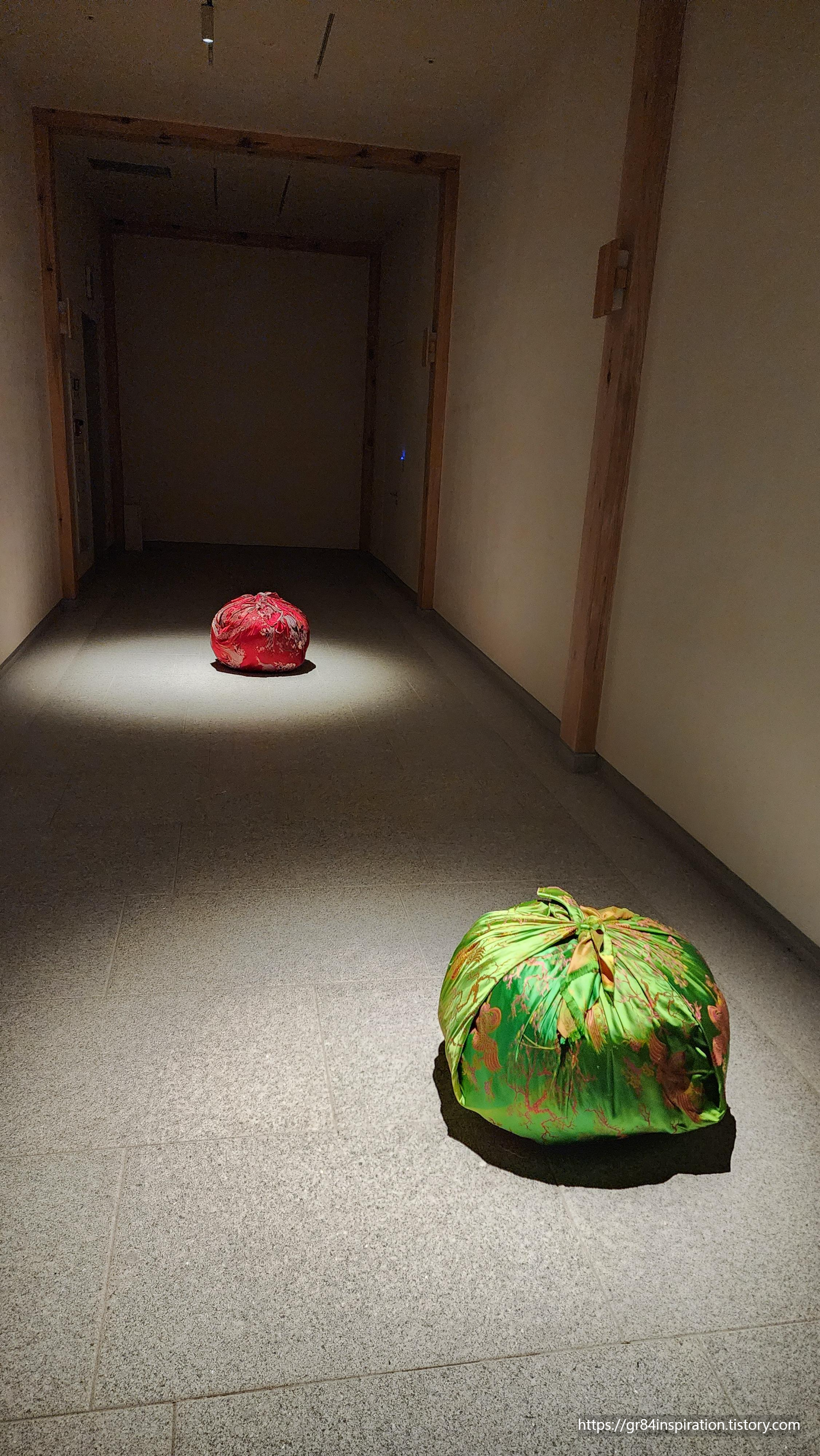
엘리베이터를 타고 지하 1층으로 내려가면, 김수자 작가의 대표작 〈보따리〉 시리즈가 기다리고 있어요.
하나는 해, 다른 하나는 달이 디스플레이된 엘리베이터를 타고 내려가는 경험 자체가 이미 예술적 행위처럼 느껴졌어요. 어두운 공간 속에서 단독 조명을 받은 화려한 색상의 보따리 두 점은, 조용하지만 강렬한 존재감을 드러냈어요.
우리 세대에게 보따리는 일상적인 물건이라기보다 ‘기억 속 이미지’에 가깝죠.
그런데 천천히 작품 앞에 서 있으니, 작가가 말한 ‘보따리는 기억과 정체성, 이동과 포용의 상징’이라는 설명이 자연스럽게 떠올랐어요.
비단천 안에 싸여 있는 건 단순한 물건이 아니라, 누군가의 삶의 조각들, 자신을 이루는 기억의 무게가 아닐까 하는 생각이 들었어요.
호흡의 끝에서 남은 것
선혜원의 한옥 공간 속에서 김수자 작가의 작품을 마주한다는 건, 전통과 현대, 물질과 개념, 개인과 세계가 서로의 숨결을 나누는 일처럼 느껴졌어요.
거울 바닥 위에서 반사된 나의 모습, 달항아리처럼 반쯤 열린 백자, 그리고 조용히 놓인 보따리들까지—그 모든 장면이 결국 ‘호흡’이라는 하나의 리듬으로 이어졌던 전시였습니다.
당신에게 ‘보따리’는 어떤 의미로 남아 있나요?
Breathing – Seonhyewon
Kimsooja: Breathing within Tradition
(Sep 3 – Oct 19, 2025, Seonhyewon, Samcheong-dong, Seoul)
Across from the Korea Banking Institute in Samcheong-dong, I took a turn down a familiar street—one I had walked countless times before. Just a few steps inward, a wide, serene hanok compound revealed itself as if it had been quietly waiting there all along. This was Seonhyewon.
Originally built in 1968 as the residence of SK Group’s founder, Seonhyewon later served as a place for education and reflection. In 2024, SK opened the site to the public as a cultural art space, launching the Seonhyewon Art Project. The inaugural exhibition featured one of Korea’s most celebrated conceptual artists, Kimsooja, in her solo show Breathing – Seonhyewon.
A Dialogue between Hanok and Contemporary Art
After making a reservation online and passing the entrance check, I climbed a short flight of stairs to find a lush green garden spread before me. Beyond it stood a large hanok in the shape of the Korean letter “ㄷ.”
Unlike the solemn beauty of palace architecture, this hanok felt both contemporary and deeply Korean. The wooden lattice doors, the subtle lines of the roof, and the carefully balanced landscaping—all came together in quiet harmony.
The exhibition unfolded across the first and basement floors of Gyeongheunggak, the main hanok building. Stepping inside, the floor was entirely covered in mirrors. The reflections of the ceiling, wooden beams, and even my own footsteps created the illusion of a space twice as large. Kimsooja invited viewers to become part of the work itself—each breath, each movement merging with the light and air of the space.
At one point, as I paused and looked around, the mirrored world beneath my feet seemed to mirror the real one above, just like the reversed gravity worlds in the film Upside Down. For a moment, reality and reflection felt indistinguishable. Wearing the protective shoe covers provided, I carefully walked across the mirrored floor, feeling as if I were momentarily walking inside the artwork itself.
The Language of the Bundle: Memory, Identity, and Care
Another room presented porcelain works created in collaboration with Meissen Porcelain in Germany.
Deductive Object – Bottari extended Kimsooja’s long-standing Bottari series—sculptures inspired by the wrapped bundles once used for travel in Korea. Two hemispherical porcelain forms, joined like a moon jar, appeared both perfectly aligned and subtly asymmetric. Within their hollow, dark interior, the idea of “emptiness” resonated with questions of existence and identity.
Nearby, Sewing into the Ground: Invisible Needle, Invisible Thread unfolded the same material into a flat, pierced surface. Countless needle holes punctured the porcelain, guiding the rhythm and direction of light. These new white works carried a different visual tone from her earlier, colorful bundles, yet the essence of her philosophy—the act of wrapping, embracing, and containing—remained intact.
Taking the elevator down to the basement, I encountered Kimsooja’s iconic Bottari installation. Even the elevator itself felt intentional—one car illuminated by the sun, the other by the moon—as if descending between day and night. In the dimly lit underground space, two vivid, fabric-wrapped bundles stood under soft spotlights, quiet yet weighty presences that filled the room.
For my generation, a bottari is not something we’ve used ourselves but rather a memory passed down—a symbol from another time. Standing before these works, I recalled the artist’s description of bottari as a metaphor for “memory, identity, migration, and embrace.”
Inside each bundle, I imagined, might lie fragments of someone’s life—things that define who they are, quietly carried from one place to another.
At the End of Breath
Encountering Kimsooja’s works within a hanok was like watching tradition and modernity, material and concept, individual and collective consciousness share a single breath.
The mirrored floor, the porcelain moon jars, and the still bundles all seemed to pulse in the same rhythm—a meditation on the act of being and breathing.
What would a bottari hold for you?
'about exhibition' 카테고리의 다른 글
| 이건희 컬렉션 The Lee Kun-hee Collection (2) | 2025.11.13 |
|---|---|
| 워너 브롱크호스트 THE WHOLE WORLD'S A CANVAS @ 그라운드 시소 서촌 (0) | 2025.10.19 |
| MMCA 과천 상설전 한국근현대미술 Ⅱ _ MMCA collection : Korean Modern an Contemporary art Ⅱ (0) | 2025.10.13 |
| 안도 타다오 × 안토니 곰리: Drawing on Space / Ground (0) | 2025.10.04 |
| 김창열 회고전 @ MMCA 서울 (0) | 2025.10.01 |